
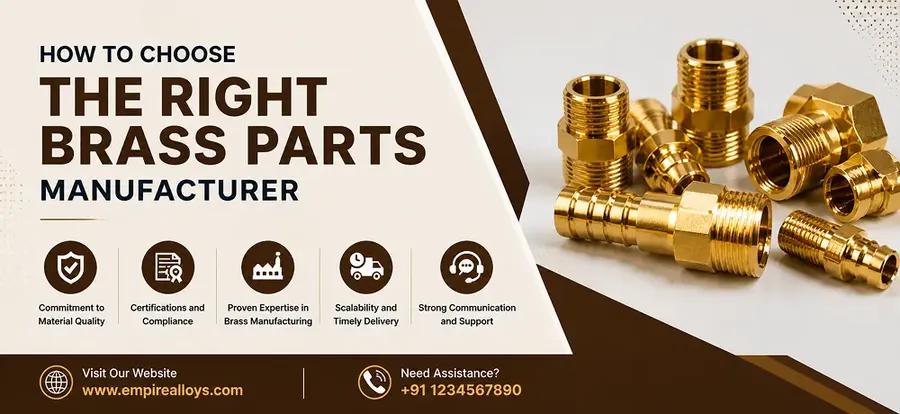
Buying brass components looks simple until a lot arrives with tight threads, the wrong alloy or a finish that tarnishes in a month. Jamnagar alone has thousands of brass part makers, so choice is not the problem. Knowing what to check is. Here are eight questions worth asking any brass parts manufacturer.
1. Where does the brass come from?
Ask whether the supplier buys rod from the market or produces it. A manufacturer with its own foundry and extrusion press controls alloy composition and machinability lot after lot. Empire Alloys, for example, casts billets in induction furnaces and extrudes rod on a 400 MT press.
2. Which alloy grades can they supply and certify?
Free-cutting brasses such as CZ121, IS 319, CW614N and C36000 are common, but some applications need lead-free, dezincification-resistant or high-conductivity material. Check that the supplier can test and confirm composition, ideally in its own lab.
3. What processes are in-house?
Turning, milling, forging, plating and packing each add risk when outsourced. The more steps done in one plant, the fewer hand-offs and delays.
4. How are parts inspected?
Look for thread ring and plug gauges, micrometers, a profile projector or vision measuring system, and a documented quality system such as ISO 9001:2015.
5. Can they work from your drawing or sample?
Most brass parts are custom. A good supplier reviews the drawing, raises questions on tolerances and threads before quoting and offers samples for approval.
6. Which finishes and packing options are available?
Nickel, tin, chrome or zinc plating and suitable packing (bags, cartons, wooden cases, pallets) prevent damage and corrosion in transit.
7. What is their experience in your product type?
Electrical parts, pipe fittings and lighting parts each have their own conventions. Ask for examples of similar parts, such as split bolts, cable glands or pipe fittings.
8. Can they meet your schedule and volume?
Share annual quantities and delivery schedules up front, and ask how capacity is planned.
A short checklist
- Own material source or verified rod supplier
- Material testing capability
- Key processes in-house
- Documented inspection and ISO 9001:2015
- Drawing review and sampling
- Plating and export packing
- Relevant product experience
- Capacity for your volume
To see how Empire Alloys answers these questions, read about our infrastructure and quality assurance.
