
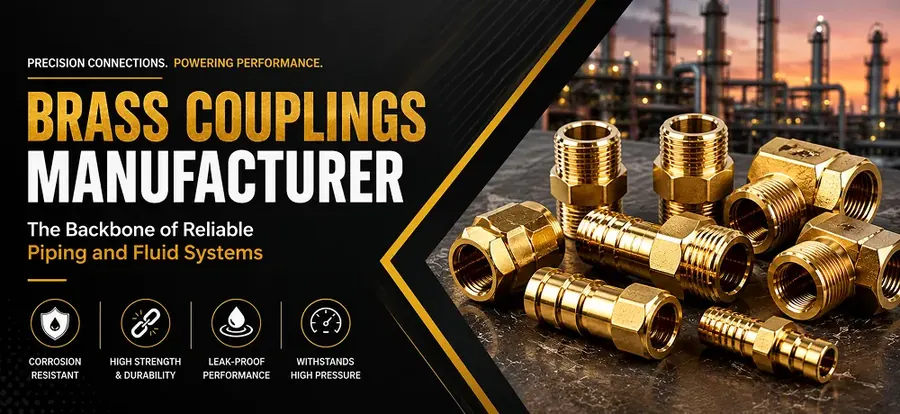
Every pipeline has joints, and in a straight run most of them are couplings. A coupling seems trivial (two female threads in one body), yet a poorly made one is where leaks, cracked threads and corrosion start. This guide explains the main types of brass coupling, what affects their quality and what to send a manufacturer when you need them made.
Why brass for couplings?
Brass combines three properties that suit pipe joints. It resists corrosion in water, air and many fluids. It machines cleanly, so threads come out sharp and accurate. And it is strong enough at the thread root to take repeated tightening. Brass also looks good, so couplings in visible plumbing do not need extra finishing, though nickel and chrome plating are available.
Main types of brass coupling
Full coupling (socket)
Female thread at both ends, joining two pipes of the same size.
Reducing coupling
Two different female thread sizes, joining a larger pipe to a smaller one.
Half coupling
Threaded one end, plain the other, often brazed onto a vessel or pipe.
Hex coupling
A hex body so a spanner can hold it during assembly.
Related fittings include reducers and bushes, nipples, elbows and adapters.
What decides coupling quality
- Bar quality. Couplings are turned from hex or round bar. Consistent alloy and straight bar give consistent wall thickness and clean threads. Empire Alloys extrudes its own bar on a 400 MT press.
- Thread accuracy. Threads should be checked with ring and plug gauges on every lot. Out-of-tolerance threads cause leaks or seizing.
- Concentricity. Both threads must share an axis, or the pipes will not align and the joint will be stressed.
- Wall thickness. Too thin and the coupling can split when tightened; too thick wastes material and cost.
- Finish. Burr-free bores and, where needed, plating suited to the environment.
Thread standards
BSP (parallel) and BSPT (taper) are standard in India, the UK and many export markets; NPT is used for North American equipment. Metric threads appear on some machinery. A taper thread seals on the thread itself, while a parallel thread usually needs a washer or sealant. Always specify both the standard and the size.
Where brass couplings are used
- Water supply and plumbing
- Compressed air lines
- Gas pipelines
- Hydraulic and lubrication lines
- Irrigation
- Industrial equipment
What to send when ordering
Thread standard and sizes, coupling type, material grade, finish, quantity per lot and annual quantity, plus a drawing for anything non-standard. With that, a manufacturer can quote accurately and avoid surprises. See our brass couplings product page for the range Empire Alloys makes.
Frequently asked questions
What is the difference between a coupling and a union?
A coupling makes a permanent straight joint; a union has a nut that lets the joint be opened without turning the pipes.
Which thread should I specify?
Use the thread already on your pipes or equipment: BSP and BSPT in India and many export markets, NPT for North American equipment.
Can brass couplings be used for gas?
Brass is widely used for gas fittings; confirm the applicable standard and pressure with your enquiry.
